
Die Kurskorrektur hat fast alle grossen Technologie-Firmen erfasst. Besonders heftig aber Oracle, wie das Wall Street Journal in einem Beitrag ausführt.

Die Kurskorrektur hat fast alle grossen Technologie-Firmen erfasst. Besonders heftig aber Oracle, wie das Wall Street Journal in einem Beitrag ausführt.

Quelle: Wall Street Journal
20 Minuten nimmt das Thema KI-Blase bei den amerikanischen Tech-Aktien auf und versucht, die Risiken für die Schweizer Pensionskassen abzuschätzen. Die Anlagen in US-Aktien werden auf 113 Mrd. veranschlagt und diverse Stimmen werden zitiert, welche u.a. von der «gefährlichsten Blase aller Zeiten» reden. Auf Anfrage hat der Asip geschrieben:
Der Schweizerische Pensionskassenverband (ASIP) sagt auf Anfrage, die Pensionskassen investieren zur Risikoverteilung in Aktien, Obligationen, Immobilen und zum Beispiel in Infrastrukturanlagen.Bei den Aktien legen die Pensionskassen schwergewichtig in Papiere von Schweizer Unternehmen an. Mit dieser Bevorzugung des Heimmarkts sind die Pensionskassen im Schnitt nicht stark in KI-Aktien exponiert. Deshalb wären die Pensionskassengelder vor dem Platzen einer KI-Blase relativ gut geschützt.Als langfristige Anleger verfügten die Pensionskassen auch über gut dotierte Puffer, um Börseneinbrüche unbeschadet auszusitzen. Sollte es bei einer Pensionskasse dennoch zu einer existenzbedrohenden Situation kommen, gebe es mit dem sogenannten Sicherheitsfonds einen Garanten, der dafür geradestehe, dass die Renten weiterhin bezahlt würden.
 In der SonntagsZeitung macht sich Jan Bolliger Gedanken über die Abhängigkeit der US-Börse und ihrer Anleger vom Erfolg der enormen Investitionen in KI bei gleichzeitig (noch) sehr bescheidenen Erträgen. Von einem Misserfolg betroffen wären Kleinsparer und Institutionelle wie unsere Pensionskassen.
MoreOpen AI setzte im ersten Halbjahr 2025 gemäss dem Portal «The Information» 4,3 Milliarden Dollar um. Das ist zwar ein stolzer Betrag und bereits mehr als im gesamten Jahr 2024. Verglichen mit einer geschätzten Bewertung von 500 Milliarden Dollar ist es aber wenig.
Zum Vergleich: Die Swisscom hat einen Börsenwert von rund 37 Milliarden Dollar bei einem Umsatz von 15,3 Milliarden. Gewinn hat Open AI bisher keinen verzeichnet, im Gegenteil: Das Start-up soll in den bisherigen Monaten dieses Jahres operativ bereits 7,8 Milliarden Dollar verloren haben.
Denn von den über 700 Millionen wöchentlich aktiven Chat-GPT-Nutzerinnen und -Nutzern bezahlen nur rund 20 Millionen für den Dienst. Gleichzeitig verschlingen das Training und der Betrieb der KI-Modelle Unsummen.
 (WSJ) After three years of roller-coaster returns, state and local government pension funds are reporting a little more normalcy. For the year ended June 30, the funds‘ median return was 8.3%, according to Wilshire Trust Universe Comparison Service. That’s about the average return for the past decade and above pension plans‘ long-term targets of around 7% per year.
This year’s stock performance drove the gains. Private equity, meanwhile, lost money for the first time since the 2008-09 financial crisis, according to a Burgiss Group index that excludes venture capital. Private equity is typically reported on a one-quarter lag. That means pension funds‘ June 30 figures reflected private equity performance for the twelve months ended March 31 and included poor performance in early 2022.
That contributed to missed targets at some of the largest plans. The California Public Employees‘ Retirement System, the nation’s biggest pension fund, reported a preliminary return of 5.8% for the year ended June 30. The second-largest, the California State Teachers‘ Retirement System, returned 6.3%.
FT. The biggest victim of last month’s US banking crisis comes from an unlikely location: Sweden.
The Scandinavian country’s largest pension fund Alecta fired its chief executive on Tuesday after a bet on niche US banks went spectacularly wrong, leading to $2bn in losses and a huge blow to its reputation in a nation where trust is foremost of all virtues.
 As the name implies, defined-benefit pensions promise to pay a set amount to retirees. While corporate America has largely moved away from this structure in favor of 401(k) options (or “defined contribution” plans), virtually all state and local governments still offer these reliable retirement payouts. And they’ve been falling behind in a big way: In the 2019 fiscal year, states had $1.48 trillion in unfunded pension liabilities, while the 50 largest local governments faced $478 billion in adjusted net pension liabilities, according to calculations from Moody’s Investors Service. The 100 largest corporate defined-benefit plans had a deficit of $285 billion in November, according to Milliman data.
That $2 trillion hole is only going to get deeper as the Federal Reserve pledges to keep interest rates near record-low levels for years to come as the U.S. emerges from the Covid-19 pandemic. Moody’s, unlike many states and cities, uses a market-based discount rate to determine the present value of a pension’s future liabilities. The lower the rate, the larger the current value. Analysts expect to apply a 2.7% rate to local governments’ fiscal 2021 reporting, down from 4.14% in fiscal 2018 and about the same as Milliman’s current discount rate for corporate pensions. It will likely cause pension shortfalls “to increase by double-digit percentages” in the next two years, Moody’s says.


Pensions have been largely moving away from stocks in recent years, a shift that has hurt performance. The median public pension fund managing at least $1 billion had 46.6% of its portfolio in equities, as of June 30, with just a 21.3% allocation to U.S. equities, according to data analytics provider InvestmentMetrics LLC. By contrast, in 2013, the oldest data available, these funds had invested 52.7% of their portfolios in stocks, with 32.1% in U.S. shares.
Now that the Federal Reserve has signaled that interest rates likely will remain low for the foreseeable future, some say pensions are looking to boost their bets on equities. Mika Malone, a managing principal at consulting firm Meketa Investment Group who works with large public pension funds and endowments, says she’s having more conversations with clients about moving additional money into stocks.
 The weak financial condition of seven US public pension plans threatens to deplete their assets by 2028, leading to severe risks for the living standards of thousands of American employees and retired workers.
Many US public pension plans had not fully recovered from the 2007/08 financial crisis before coronavirus struck, triggering turmoil across financial markets. The correction in the US stock market has increased the long-term structural problems across the entire US public pension system, particularly for the weakest funds.
“Public plans with extremely low funded ratios in 2020 may face the risk of running out of assets in the foreseeable future if markets are slow to recover,” said Jean-Pierre Aubry of the Center for Retirement Research at Boston College, which carried out a detailed study on the plight of US public pensions.
 Senior US senators are demanding that one of America’s biggest government pension funds reverse a decision that is set to channel billions of US dollars into funding Chinese companies that they say support Beijing’s military, espionage and domestic security efforts.
The demand shows how the US-China rivalry, which has thus far focused mainly on trade war tensions, is spreading further into the arena of financial markets.
Senators Marco Rubio, a Republican, and Jeanne Shaheen, a Democrat, told Michael Kennedy, chairman of the Federal Retirement Thrift Investment Board, in a letter that his fund is supporting Chinese state-owned companies with “the paychecks of members of the US Armed Services and other federal government employees”.
The letter — a copy of which was seen by the Financial Times — said an impending investment shift by the FRTIB would mean that about $50bn in US government pensions becomes exposed to the “severe and undisclosed” risks of being invested in selected Chinese companies.
 The American Legislative Exchange Council (ALEC) releases today, Unaccountable and Unaffordable 2018 – its newest publication in an annual series illustrating the growing pension crisis facing public employees and taxpayers. To understand the scope of the crisis, state pensions across the country are funded at an average of 35% of what they should be. This translates into an average of $18,300 in unfunded pension liabilities for every man, woman and child across the United States. The new report measures nearly 300 state-administered pension plans and in total, they have unfunded liabilities of nearly $6 trillion.
 Life expectancy for Americans fell again last year, despite growing recognition of the problems driving the decline and federal and local funds invested in stemming them.
Data the Centers for Disease Control and Prevention released on Thursday show life expectancy fell by one-tenth of a year, to 78.6 years, pushed down by the sharpest annual increase in suicides in nearly a decade and a continued rise in deaths from powerful opioid drugs like fentanyl. Influenza, pneumonia and diabetes also factored into last year’s increase.
Economists and public-health experts consider life expectancy to be an important measure of a nation’s prosperity. The 2017 data paint a dark picture of health and well-being in the U.S., reflecting the effects of addiction and despair, particularly among young and middle-aged adults, as well as diseases plaguing an aging population and people with lower access to health care.
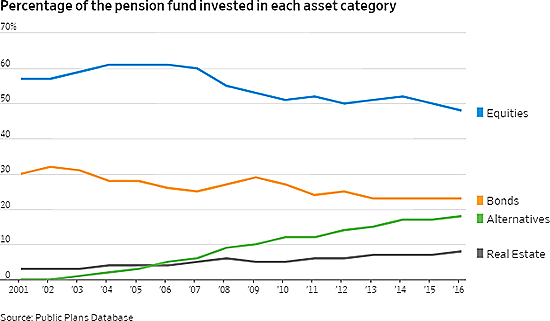
The largest U.S. public pension fund debated in December whether to sell more than $50 billion in stocks as global markets raced higher. But in the end, the board of the California Public Employees’ Retirement System decided it was fine to hold more.
Retirement systems that manage money for firefighters, police officers, teachers and other public workers aren’t pulling back on costly bets at a time when markets are rising around the world.
Some public pension funds are adding to traditional allocations of stocks and bonds while both are expensive. Others are loading up on more private-equity or real-estate holdings that are less liquid and sometimes carry high fees.
How much risk to take is a question facing all investors as they enter 2018. «Everything is overvalued,” said Wilshire Consulting President Andrew Junkin, who advises public pension funds. “There’s no magic option out there.”
In der NZZaS erklärt Prof. Raimond Maurer, warum das amerikanische Vorsorgesystem besser sei als das schweizerische.
Umwandlungsätze sind Leistungsversprechen, die den Versicherten sehr teuer zu stehen kommen. Wenn sich die Lebenserwartung und das Zinsniveau verändern – und beide Parameter laufen im Moment gegen unsere Vorsorgewerke -, steigen deren Verpflichtungen empfindlich.
Sobald man solche feste Rentenzusagen mache, müsse man jedes Jahr bilanzieren und die Vermögen den Verpflichtungen gegenüberstellen, sagt Maurer. Die direkte Konsequenz: Nur ein kleiner Teil der Anlagen könne so noch in Aktien gehalten werden, alles andere wäre ein Vabanquespiel.
Drei US-Pensionsfonds haben sechs Grossbanken angeklagt mit dem Vorwurf einer missbräuchlichen Kreditvergabe. Betroffen sind neben Bank of America, Goldman Sachs, J.P. Morgan Chase und Morgan Stanley auch die Schweizer Institute Credit Suisse und UBS, wie das «Wall Street Journal» schreibt.
Den Banken werde vorgeworfen, seit 2009 zusammengearbeitet zu haben, um Wettbewerb zu verhindern. Die Sammelklage von Iowa Public Employees‘ Retirement System, Orange County Employees Retirement System und Sonoma County Employees‘ Retirement System sei am Mittwoch am Bundesgerichtshof für den südlichen Bezirk von New York eingereicht worden. Die Banken wollten dies gegenüber der Handelszeitung nicht kommentieren oder waren für ein Statement nicht erreichbar.

For years, many pension funds assumed they would earn an average 8 percent annually from their investments. It was a reasonable expectation for a while. But times have changed. Now, the question isn’t whether return expectations should be lower, but by how much. The average target has fallen toward 7.5 percent, but that’s still probably difficult to meet without taking excessive risk.

